
Background
The Barnes TTSX is an immensely popular hunting projectile and for good reason. For those unfamiliar, the Barnes TTSX is the polymer tipped brother of the Barnes TSX; a monolithic copper bullet designed for deep penetration and controlled expansion.
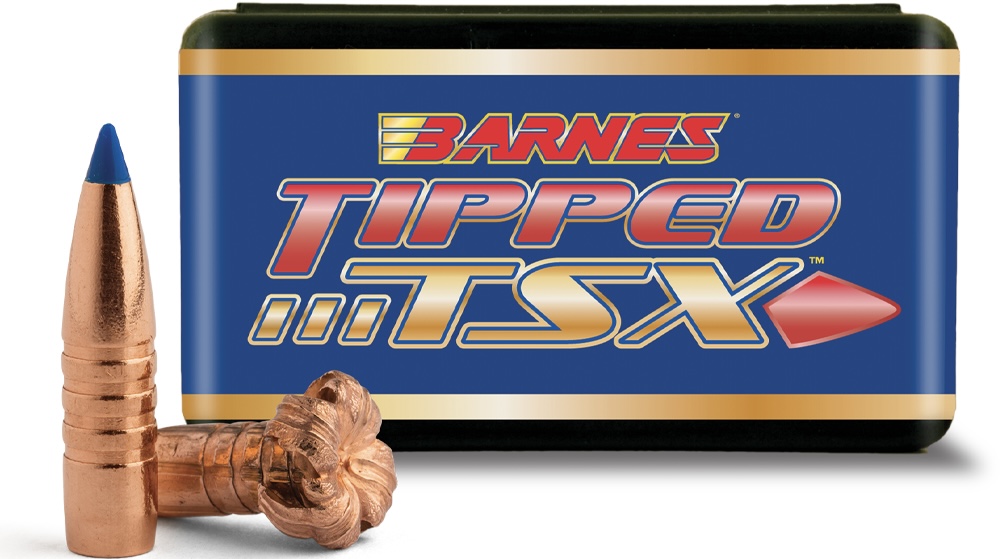
One thing to note about monolithic copper bullets is that a bullet of the same dimensions will naturally weigh less than a regular cup-and-core bullet (such as the Hornady Interlock) due to the copper bullet not have a lead core.
Another thing to note is that monolithic copper bullets rely heavily on velocity to facilitate expansion, this often results in those shooting an all-copper bullet going a little bit lighter than they normally would. For example, Barnes makes 30-caliber TTSX bullets between the range of 110-180 grains whereas the Hornady Interlock will start out at 150 grains and go all the way up to 220 grains.
Purpose
My purpose for this load development is to harvest whitetail deer between the range of 30 – 150 yards. For my situation, nearly any projectile or factory box of hunting ammo would do the trick, but I am excited and looking forward to the process of beginning with load development and ending up with a nice buck come deer season.
NOTE: My loads are created for my specific rifle and at my own risk. My loads may not be safe in other rifles. Always do your own research and tests. Do not trust load data or follow reloading practices from random people on the internet.
The Rifle
The rifle I will be developing for is actually a recent build of mine. It is a .308 Howa Model 1500 featuring a 24-inch heavy barrel. I bought this as a barreled action and put it in a Bell and Carlson Tactical stock, topped it with a Vortex Eagle 4-16x42mm scope, and finished it off with a Harris bipod and a Bergara Omni muzzle brake. While this rifle was primarily built with precision target shooting in mind, I figured that its weight shouldn’t be an issue in a treestand.
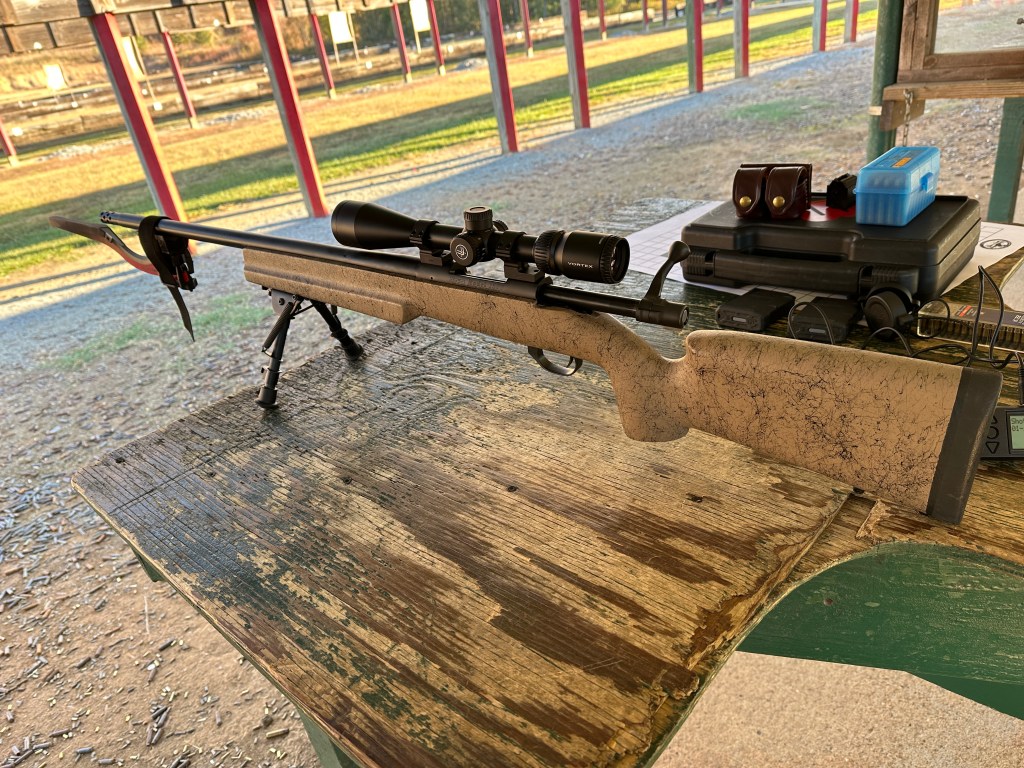
This rifle is brand new. I have only shot a handful of rounds through it, all of which being 178gr Hornady ELD-M handloads. From the handful of rounds I have put through it so far, this rifle is an absolute tack driver. I am exciting to see how it handles the TTSX.
Researching Load Data
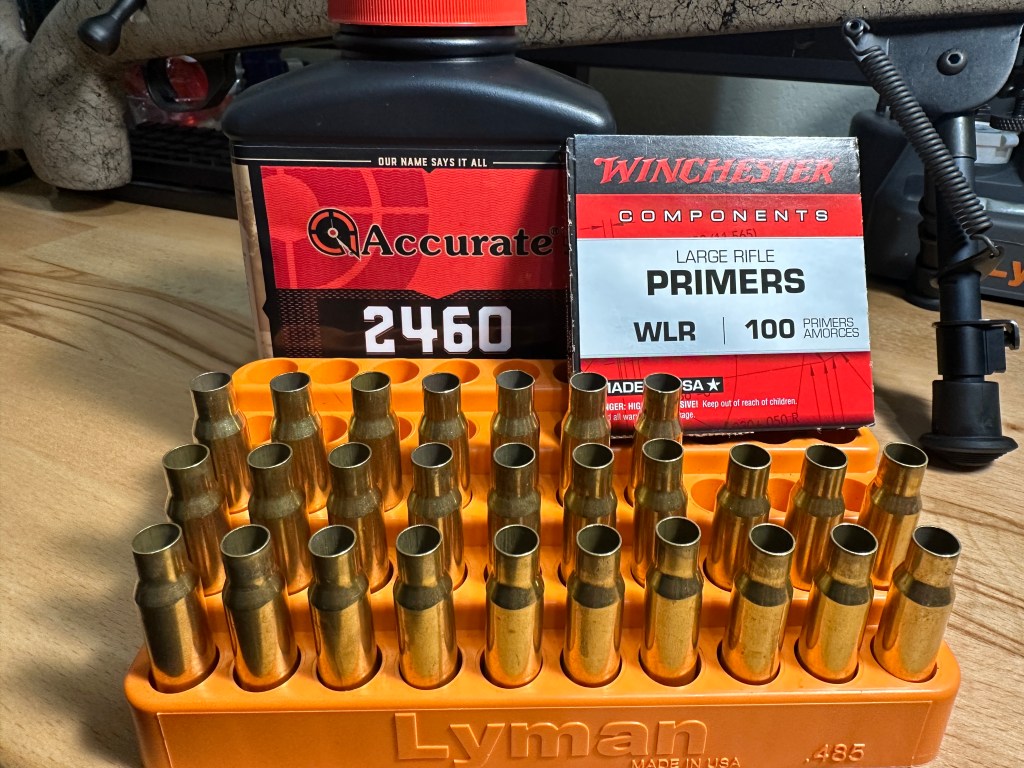
Researching load data for a popular cartridge and a popular projectile is extremely easy. My first stop was Accurate’s Reloading Data Center (RDC). The RDC listed a multitude of powder options from all major powder manufacturers. Given my current component stock, I decided to start with Accurate 2460. Accurate 2460 was the powder I chose when loading the 178gr ELD-M’s and I had great success with it.
The LDC lists a starting load of 38.7 grains and a max load of 43.0 grains, achieving projected velocities of 2,465ft/s and 2675ft/s, respectively.

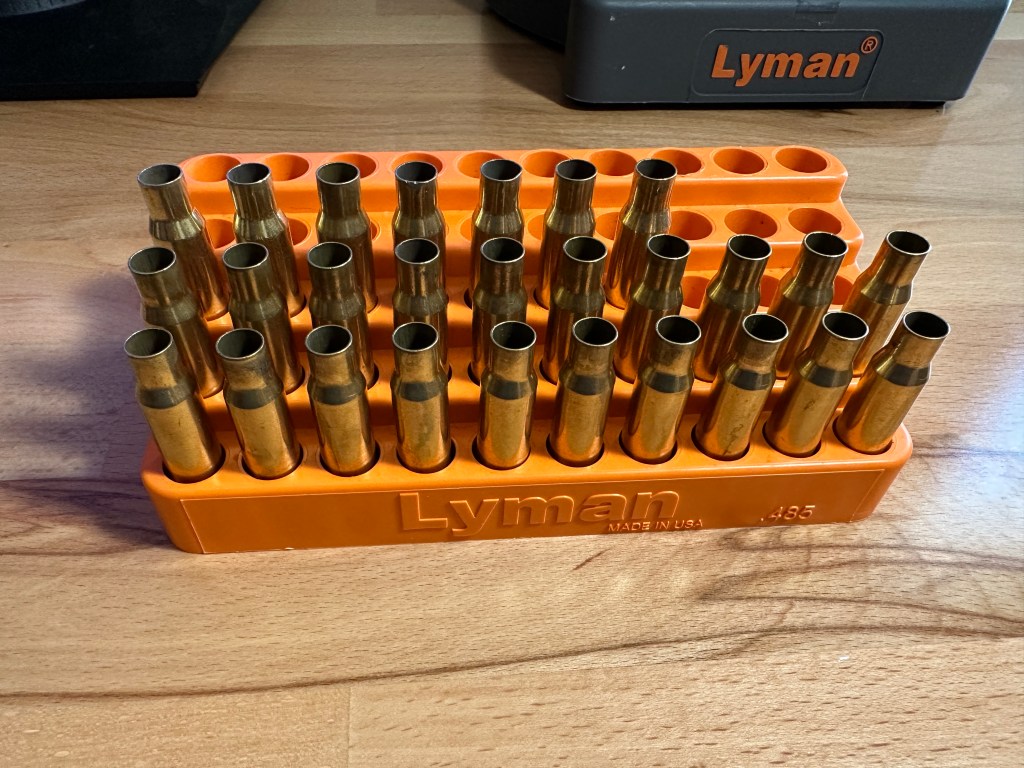
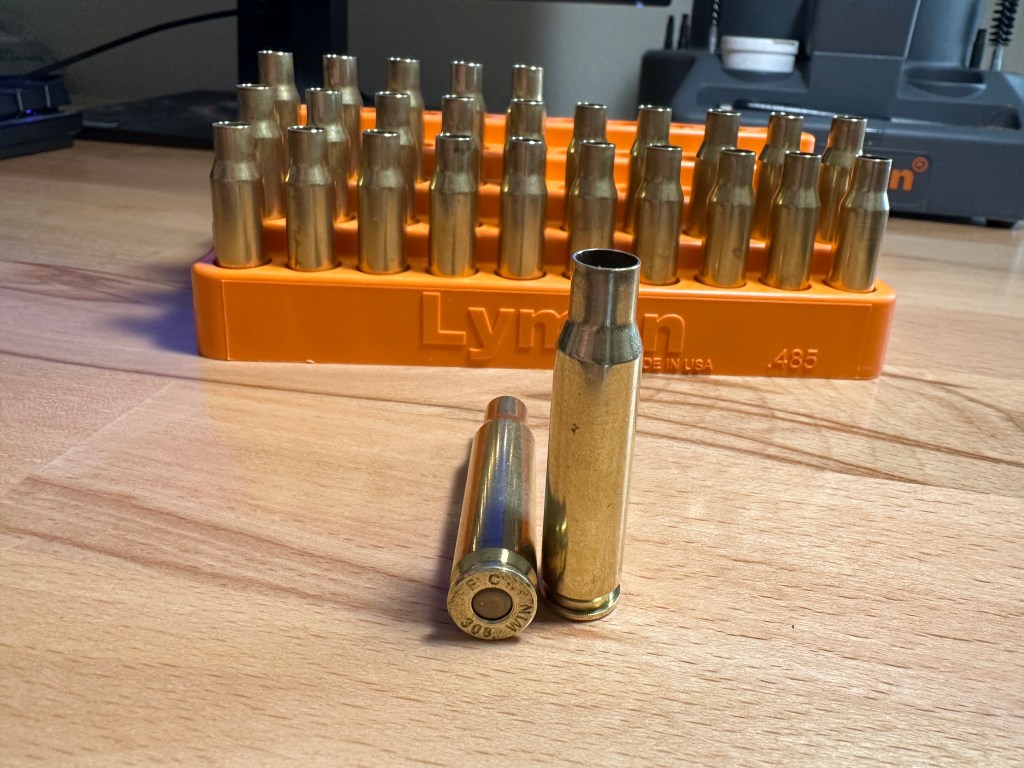
For brass, I am going to start out by using once-fired brass that I picked up from my local range. I sorted through my cleaned .308 brass stock and set aside 27 pieces of Federal brass to use in my initial development. I plan on using this Federal once-fired brass to do the initial load development, but once I begin the process of fine tuning the load I will switch to new Starline brass. I will be using Starline brass for the final rounds that will be going into the woods with me.
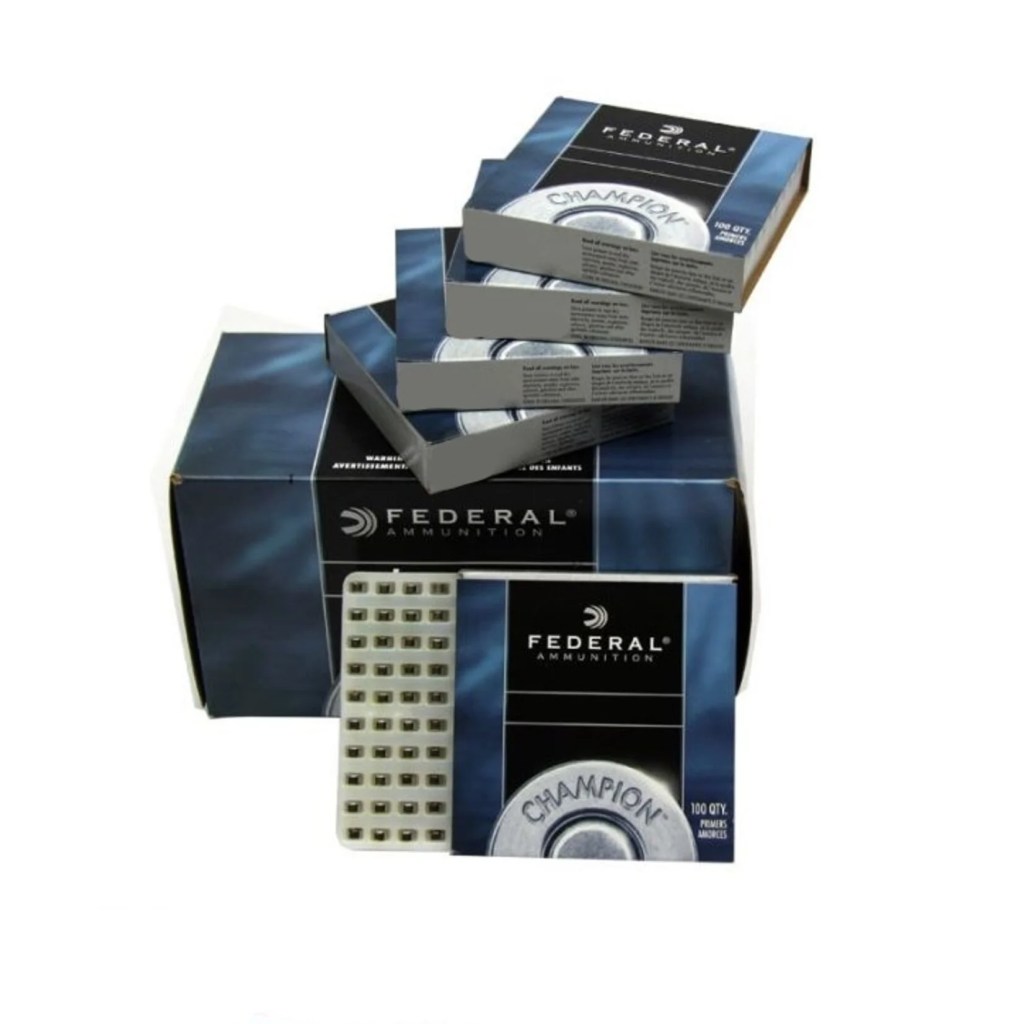
For the primers, I will be using Winchester Large Rifle (WLR) primers. It was between WLR and CCI Large Rifle, I just have more of the WLR’s on hand.
Planning the Ladder Tests
For my initial ladder tests, I decided to just even distribute my powder charges starting at 41.0 grains and going up to 42.6 grains.
| Powder Charge (in grains) | # of Rounds Loaded |
| 41.00 | 3 |
| 41.20 | 3 |
| 41.40 | 3 |
| 41.60 | 3 |
| 41.80 | 3 |
| 42.00 | 3 |
| 42.20 | 3 |
| 42.40 | 3 |
| 42.60 | 3 |
Normally, I would load 5 rounds for each powder charge. However, given the relatively high cost of the Barnes TTSX, I will be loading 3 rounds per powder charge for the initial ladder test. This will give us 27 total rounds. Once we get the powder charges narrowed down, I will up the number of rounds loaded.
Load Specs
I decided to set my cartridge overall length (COAL) to 2.800″. This length worked great with the 178gr ELD-M, so I decided I would go with this for the TTSX and see how well it would work. That is really the only specification for this load, I did not crimp or do anything else other than simply seating the bullets.
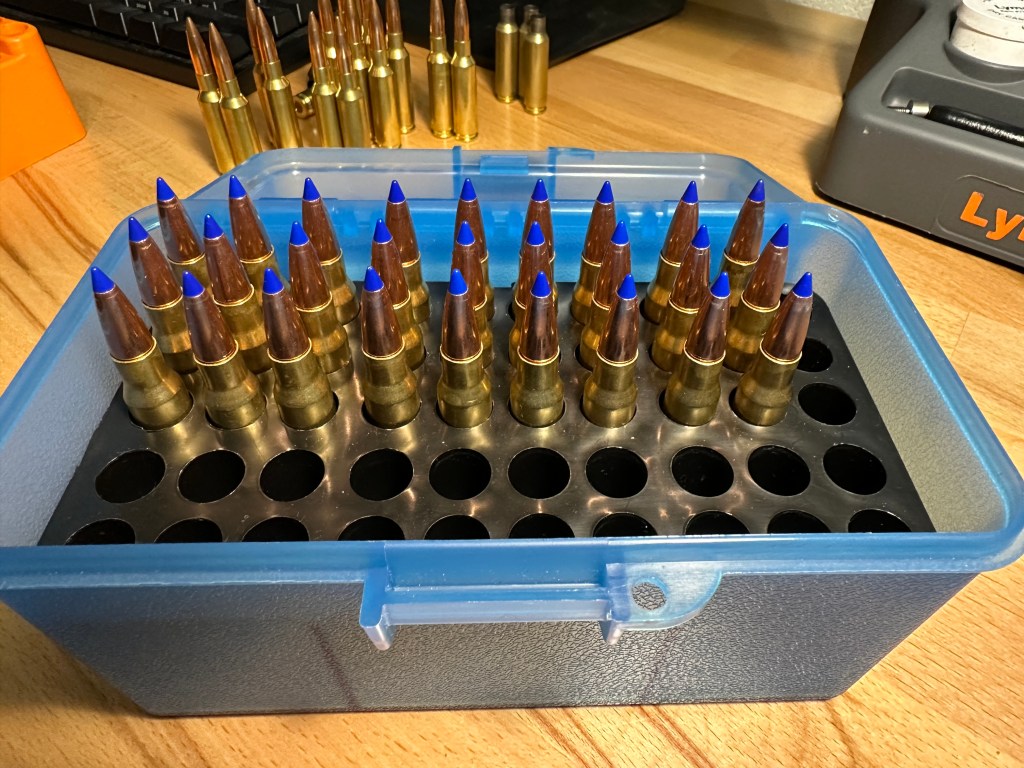
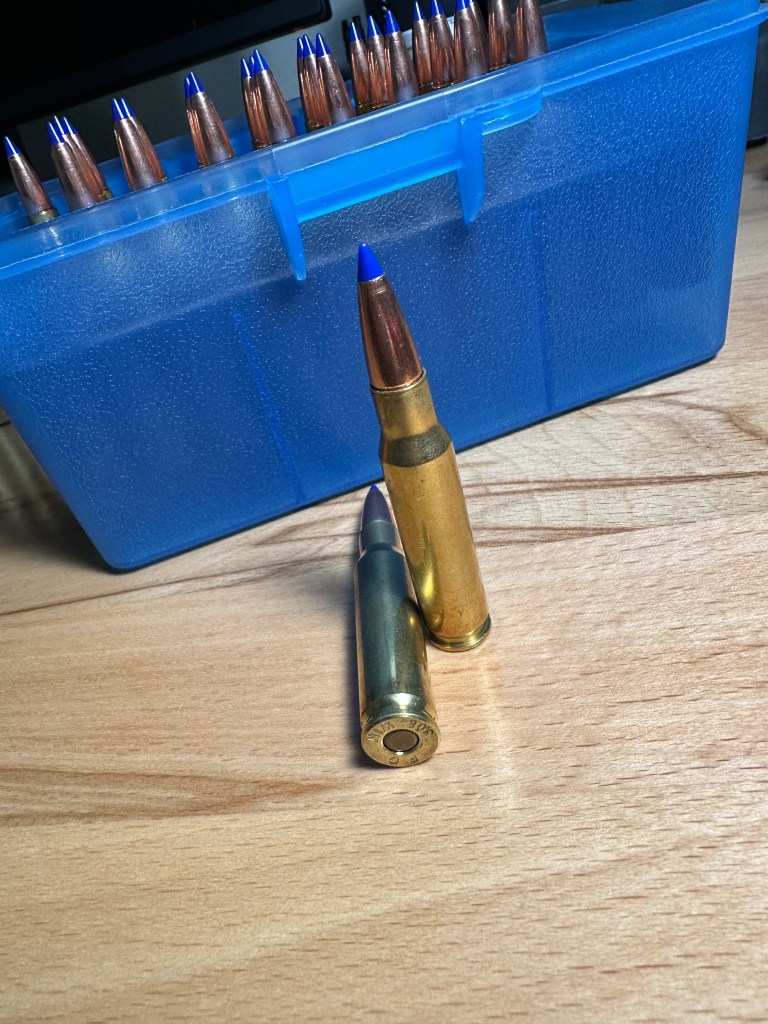
With all 27 of the initial rounds loaded, it was time to take them to the range to see how they performed.
Range Day and Testing Procedures
Aside from group size (which I will be measuring using the BallisticX iPhone app), part of measuring the performance of these rounds would also include velocity standard deviation and extreme spread. In order to capture this data, I will be using my trusty MagnetoSpeed chronograph. I will be cleaning my rifle thoroughly before heading out to the range. Regarding my methodology for testing these rounds, I will be shooting 100 yards. I will be shooting no more than 2 charge weights (6 rounds) in one sitting, this will prevent barrel heat from affecting the rifle’s groupings. Further, at the beginning of the range session, I will fire an unrelated round (one of the 178gr ELD-M’s I have been mentioning) out of the rifle in order to prevent the cold bore from affecting my test. All of the chronograph data and group sizes will be included in the “Initial Range Results” section below.
Initial Range Results
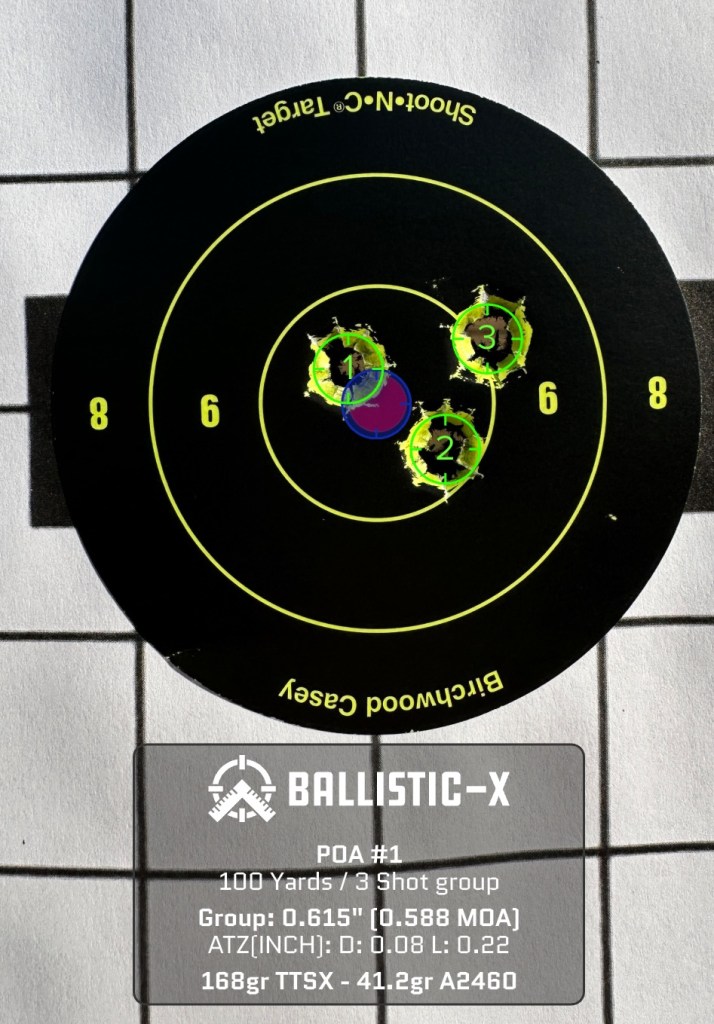
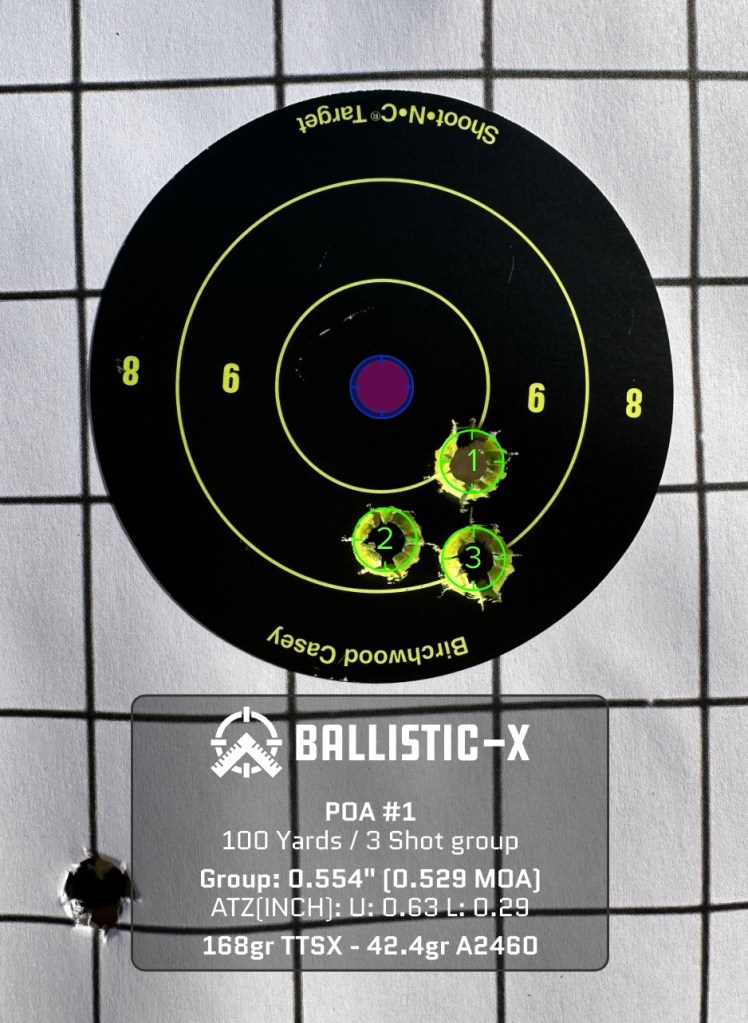
My initial thoughts after shooting all 9 charge weights are that any of the 27 total rounds I shot would have handled its business come deer season. However, some of the charge weights performed noticeably better than the others. To be fair, I am sure some of these flyers were a result of my skill, or lack thereof. Of the 9 charge weights, 41.2 grains and 42.4 grains shot the best groups:
Here are the rest of the groups:
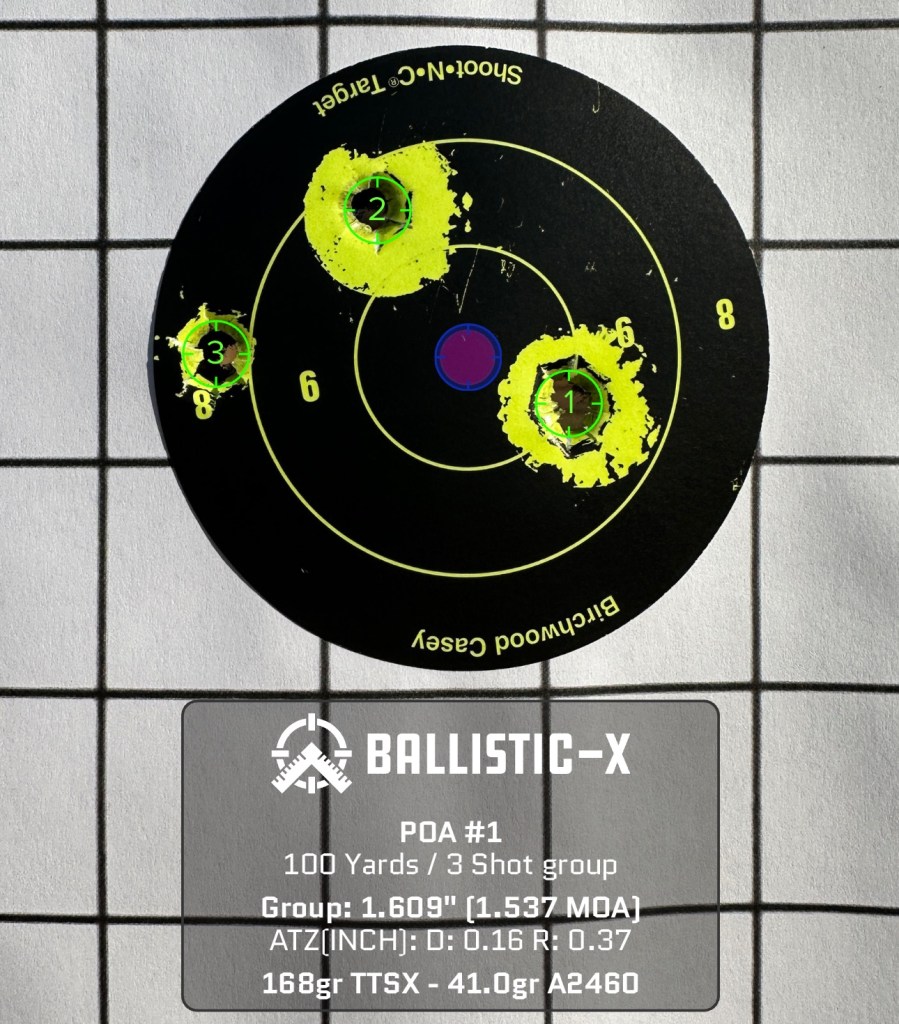
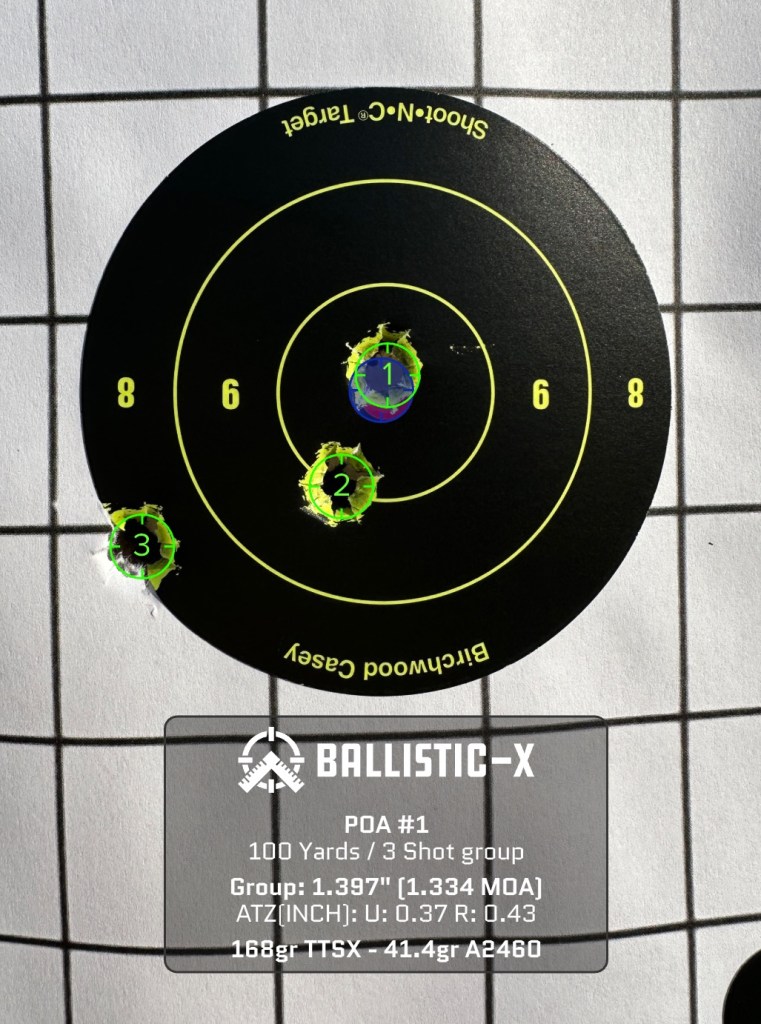

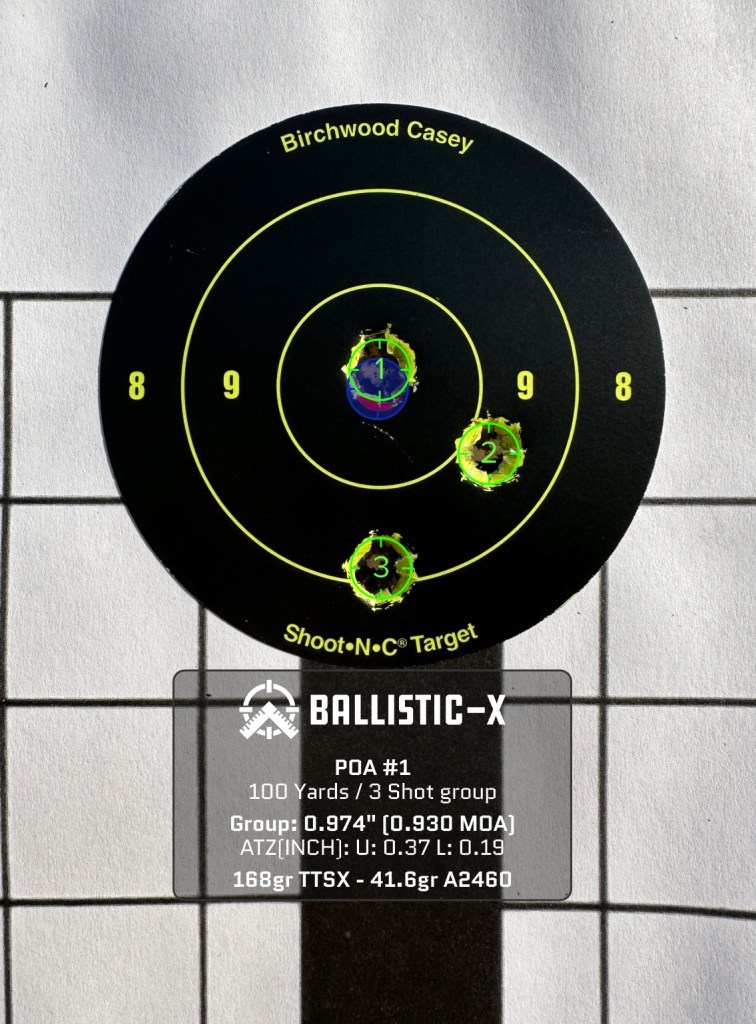
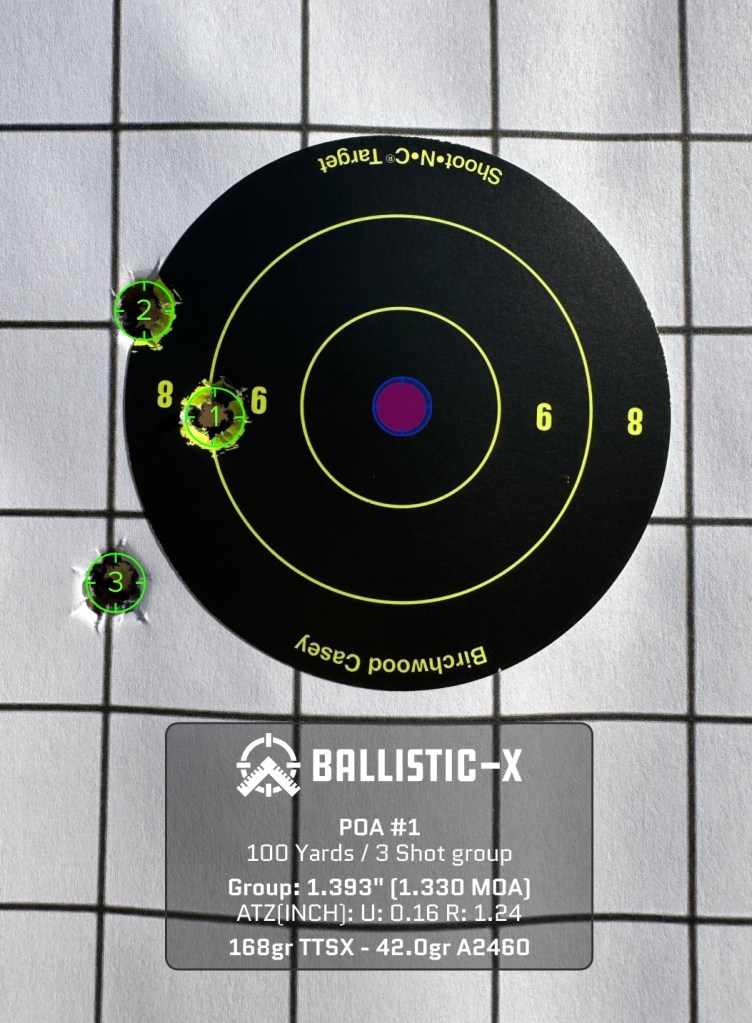
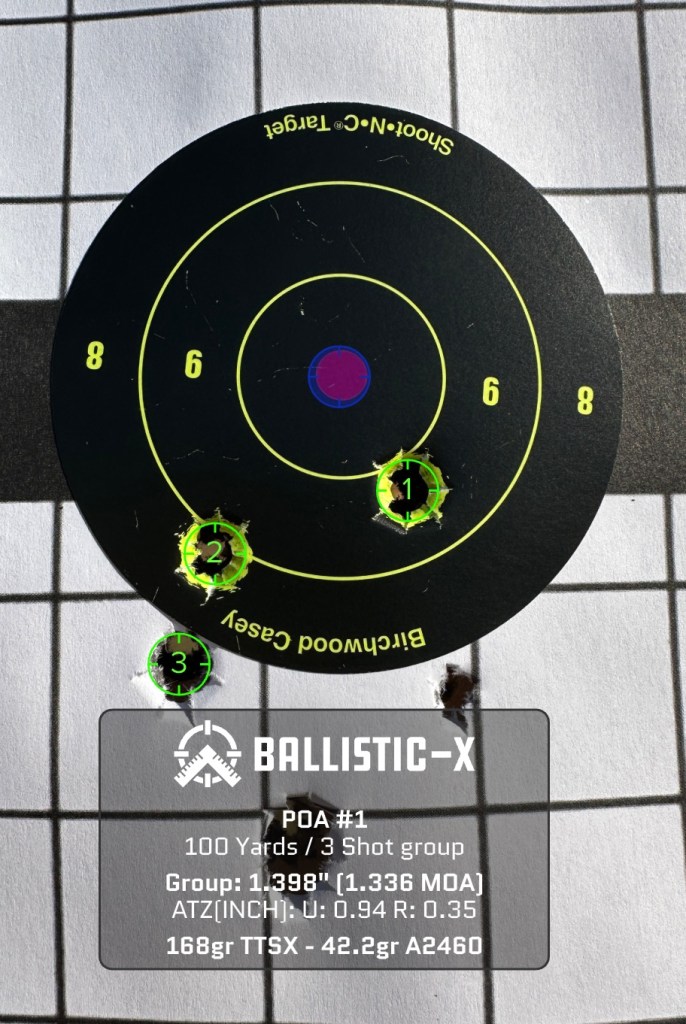

Regarding velocities, all 9 charge weights performed very well. See the data in the table below.
| Charge Weight (in grains) | Average Velocity (ft/s) | Standard Deviation (ft/s) | Extreme Spread (ft/s) |
| 41.00 | 2,579 | 2.52 | 5 |
| 41.20 | 2,597 | 14.98 | 29 |
| 41.40 | 2,632 | 4.16 | 8 |
| 41.60 | 2,630 | 3.79 | 7 |
| 41.80 | 2,629 | 20.21 | 40 |
| 42.00 | 2,656 | 10.97 | 21 |
| 42.20 | 2,658 | 22.07 | 44 |
| 42.40 | 2,678 | 5.69 | 11 |
| 42.60 | 2,662 | 13.65 | 27 |
I was fairly happy with most of this data, however it appears that the average velocities for some of the charge weights did things I was not expecting. These velocities should be more than enough to facilitate reliable expansion out to 200 yards. Based on the numbers and groups, my favorite charge weights of the 9 are 41.20 and 42.40. These are the charge weights I will continue with in my load development. I am happy with these groups for my deer hunting, so I will skip the step where I would experiment with the COAL and bullet seating depth. Instead, my next step will be to load up a larger quantity of these 2 charge weights and conduct further testing at the range in an attempt to identify which charge weight I want to take into the woods with me this season.
Range Day Part 2
Stay tuned, post last updated on 10/30/24.
 Bullet and Bench